
Understanding Chattanooga Code Enforcement: What They Do (and Don’t Do)
Understanding Chattanooga Code Enforcement: What They Do (and Don’t Do) to Help Keep Hill City Beautiful and Safe
At the Hill City Neighborhood Association, we’re all about bringing neighbors together to build a thriving, connected, and vibrant community right here in Chattanooga. One key way we protect and enhance that pride is by staying informed about the city services that support safe, well-maintained neighborhoods—like Chattanooga’s Code Enforcement Department.
Whether you’ve noticed overgrown lots, scattered litter, or an abandoned vehicle impacting the block, Code Enforcement plays an important role in addressing these issues on private property. Their work helps prevent blight, protects public health and safety, and a higher quality of life for all of us.
In this post, we’ll break down exactly what Code Enforcement does, what falls outside their scope (and who to contact instead), and how you—as a Hill City resident—can partner with them to keep our neighborhood looking its best. We’ve pulled the latest info straight from official city resources, including their helpful brochure, so you have clear, reliable guidance at your fingertips.
Together, by reporting concerns thoughtfully and maintaining our properties, we can continue making Hill City a place we’re all proud to call home. Let’s dive in!
Summary of What Chattanooga Code Enforcement Does
From the official city sources, Code Enforcement (part of the Land Development Office under Public Works) focuses on protecting public health, safety, and welfare by enforcing the city’s property maintenance codes. Their primary responsibilities include:
• Enforcing minimum housing standards for existing structures and properties.
• Addressing blight issues such as:
• Litter and illegal dumping on private property.
• Overgrowth (e.g., tall grass, weeds, vegetation).
• Inoperable or abandoned vehicles on private property.
• Other property maintenance violations that affect neighborhood safety and livability.
• Conducting complaint-driven inspections (citizens report issues via 311 or online at Chattanooga.gov) and sometimes systematic neighborhood inspections (which neighborhood associations can request).
• Issuing Notices of Violation (NOV), re-inspecting properties, and escalating non-compliance to Environmental Court if needed.
• Working toward quick compliance to bring blighted properties up to standard, often starting with education and courtesy notices.
The process is largely reactive to citizen reports, though they also run proactive “blitz” or comprehensive inspections in targeted districts to enhance overall neighborhood conditions.
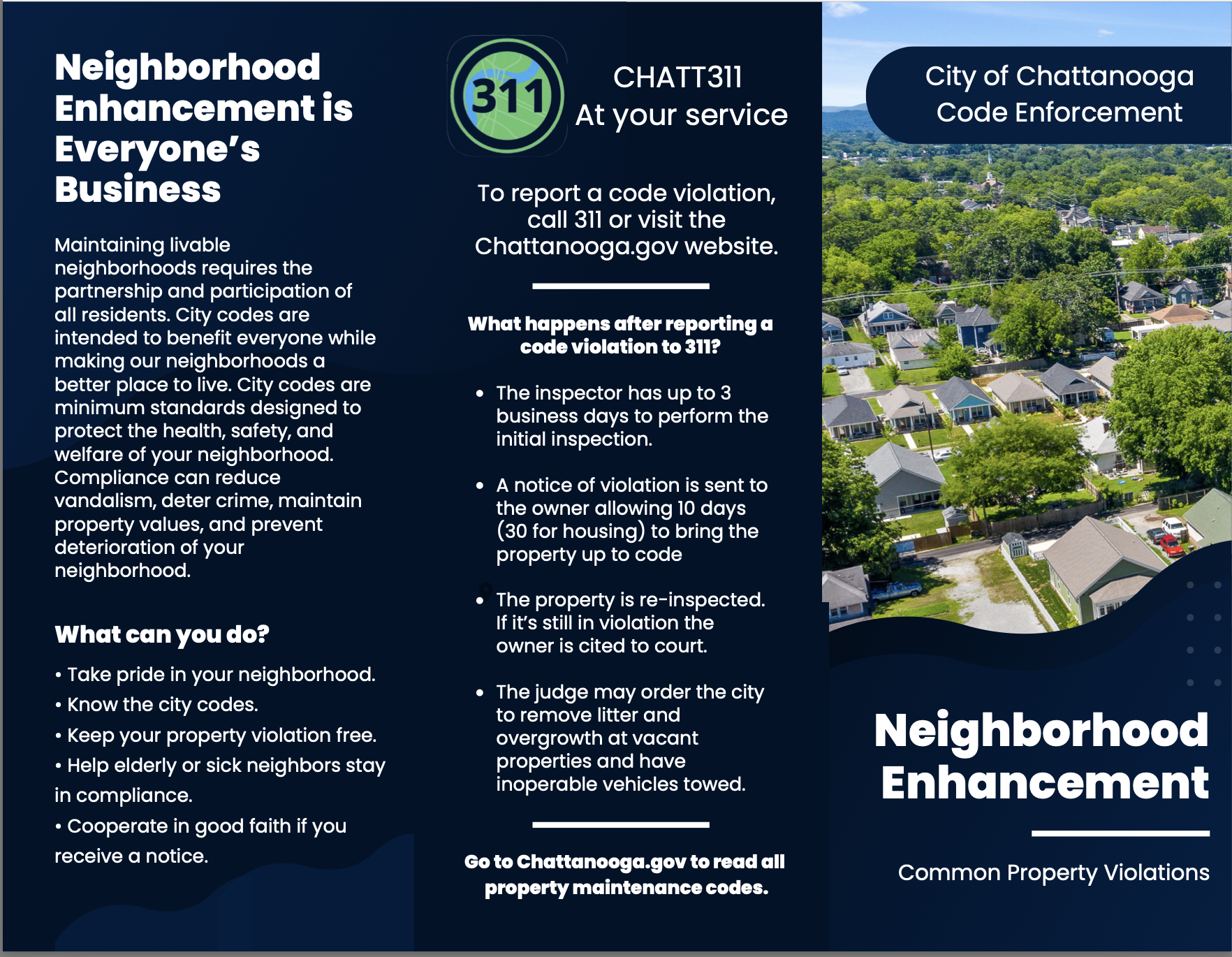
City of Chattanooga Code Enforcement brochure
What Chattanooga Code Enforcement Does NOT Do
Official city pages don’t provide an exhaustive “does not do” list, but based on their described scope and separation of duties:
• They do not handle new construction, building permits, or inspections for new/altered structures (that’s under the Land Development Office’s Building Inspection Services, which enforces adopted building, electrical, plumbing, etc., codes).
• They do not enforce fire codes (handled by the Chattanooga Fire Department’s Fire Prevention Bureau/Fire Marshal).
• They do not deal with issues like criminal activity, noise complaints, or animal control (those fall under Police, other departments, or Hamilton County services).
• They do not enforce on public property/rights-of-way in all cases (focus is primarily private property).
• They are not involved in private disputes between neighbors unless it involves a clear code violation (e.g., overgrowth affecting health/safety).
For the most accurate and up-to-date details, check out the links below:
• Report a violation (includes more on the process after reporting)
Keeping Hill City Strong—One Neighbor at a Time
Chattanooga’s Code Enforcement team is a valuable partner in our shared goal of maintaining safe, attractive, and livable neighborhoods. By focusing on private property issues like overgrowth, litter, inoperable vehicles, and minimum housing standards, they help prevent blight from taking hold and support the health, safety, and property values we all care about in Hill City.
Remember: Their work is largely driven by community reports, so your observations make a real difference. When you spot a potential violation, use the easy tools like Chattanooga.gov, the 311 app or calling 311 to get it on their radar. For bigger neighborhood-wide concerns, reach out to request a systematic inspection—our association can help coordinate that too.
Of course, Code Enforcement isn’t the answer for every issue. New construction permits, fire safety, noise complaints, or public right-of-way problems fall to other city departments, so knowing who to contact saves time and gets results faster.
Ultimately, the best defense against blight is all of us—staying proactive with our own properties, looking out for one another, and reporting concerns respectfully. When we combine neighborly care with the city’s enforcement tools, Hill City stays the beautiful, historic, and welcoming place we love.
Check out the official Code Enforcement Brochure (English/Spanish) for more details, and visit the city’s Code Enforcement page or services overview anytime.
Thanks for being an engaged neighbor. Together, we’re building the thriving Hill City we all deserve.
Have questions or ideas? Drop them in the comments below or join us at our next meeting—we’d love to hear from you!